

From New Zealand to Manta: a sanctioned vessel and the silence of the State
- Franklin Vega
- Apr 1
- 5 min read
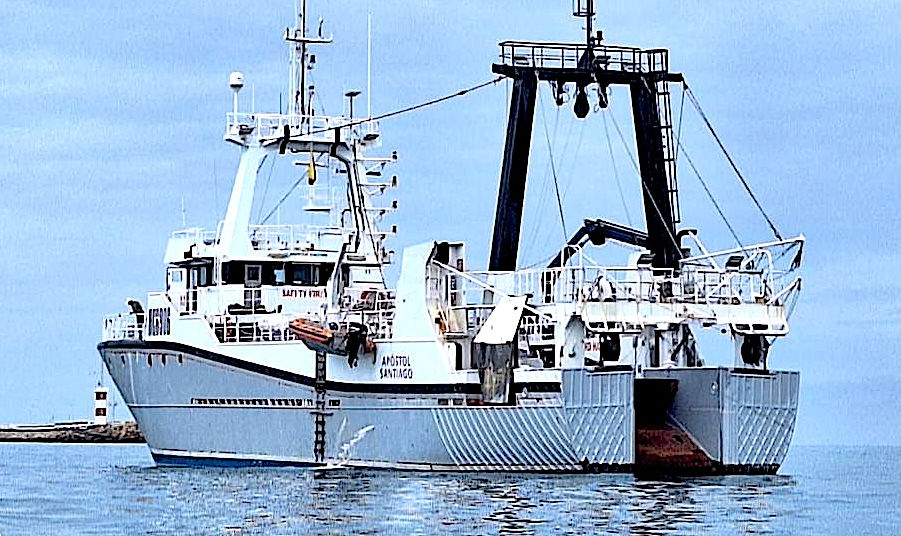
The story of the industrial trawler Apóstol Santiago — formerly known as Amaltal Apollo — does not begin in Ecuador. It begins thousands of kilometers away, in New Zealand, within one of the most structured and tightly regulated fisheries management systems in the world.
That origin matters.
Because before arriving in the Ecuadorian port of Manta, the vessel had already been sanctioned for illegal fishing in the South Pacific, in an area closed to protect vulnerable marine ecosystems under the South Pacific Regional Fisheries Management Organisation (SPRFMO). The violations occurred in 2018, and in 2022 both the vessel’s captain and its operating company — a subsidiary of Talley’s Group, one of New Zealand’s largest seafood companies — were convicted.
In New Zealand, such cases are not minor. They are part of a broader compliance system designed to protect the integrity of the Quota Management System (QMS), a globally recognized framework that regulates fishing through strict catch limits, monitoring, and enforcement.
Yet, despite that legal history, the vessel re-entered the international market.

From enforcement to export
In New Zealand, vessels that have gone through legal processes — including sanctions — can return to the market once penalties are resolved. This reflects a system where compliance is enforced through courts, fines, and, in some cases, confiscation.
But it also raises a question for international partners:
What happens when a vessel that has already tested the limits of one of the world’s most robust fisheries systems is transferred to jurisdictions with weaker transparency or enforcement mechanisms?
That question becomes central in Ecuador.
The Ecuadorian chapter: quotas before the business
The vessel’s arrival in Ecuador was not spontaneous. It was enabled by a sequence of administrative decisions that began in 2023, when fishing quotas were granted to an individual with no known track record in industrial fisheries.
Those quotas later became the foundation for a company created in 2025 — Pesquera Mar de Rías Ecuador — which would ultimately import and operate the vessel.
The timeline is critical.
First, the quotas.Then, the company.Finally, the vessel.
For observers familiar with fisheries governance, this inversion raises red flags. In most regulated systems, access to resources follows demonstrated capacity, experience, and technical evaluation. Here, the sequence appears reversed.
Revolving doors and structural advantage
The case becomes more sensitive with the involvement of a former Ecuadorian fisheries authority who served as Undersecretary of Fisheries at the time the quotas were granted. He later appeared as a shareholder in the company that would use those quotas, before formally exiting prior to the vessel’s final authorization.
While not necessarily illegal, this sequence reflects what governance experts describe as a “revolving door” dynamic: the movement between public office and private benefit, where institutional knowledge and influence can translate into structural advantage.
In New Zealand, such situations are closely scrutinized through conflict-of-interest rules and transparency mechanisms. In Ecuador, the absence of public explanations has left these questions unresolved.
Legal approval — without public explanation
By December 2025, Ecuadorian authorities approved the importation of the vessel, stating that there were no legal impediments.
However, the technical and legal reports supporting that decision have not been made public, despite formal requests.
The Ministry of Agriculture — which oversees fisheries — has not explained:
how the quotas were granted,
what criteria were applied,
or how the vessel’s international track record was assessed.
In January 2026, the vessel arrived in Manta.
A valuation that raises questions
The vessel was declared in Ecuadorian customs at approximately USD 500,000.
In the international market, similar vessels can reach values of up to USD 2 million, depending on condition and equipment.
Even more striking, the onboard equipment — including sonar, radar, cranes, and generators — can itself approach or exceed that declared value.
This discrepancy does not prove wrongdoing. But it does raise a basic question:
Was the declared value consistent with the real transaction?
So far, authorities have not provided an answer.
A vessel that could reshape a fishery
Beyond administrative concerns, the Apóstol Santiago represents a structural shift in Ecuador’s merluza (hake) fishery.
As an industrial freezer trawler, it can operate longer at sea, process catches onboard, and concentrate fishing effort at a scale that may equal or exceed that of multiple smaller vessels.
In fisheries where resources are shared and spatially concentrated, this kind of technological asymmetry can redefine competition, access, and ultimately, distribution of the resource.
The “research vessel” question
Another possibility has emerged in Ecuador: reclassifying the vessel as a research or experimental fishing platform.
In principle, scientific research is essential for sustainable fisheries management. In practice, however, such classifications require:
clear scientific objectives,
independent oversight,
transparent methodologies,
and public reporting of results.
Without those safeguards, “research” risks becoming a regulatory shortcut — a way to introduce industrial fishing capacity without full scrutiny.
A pattern beyond one vessel
The case of the Apóstol Santiago is not isolated. Other fishing quotas have been granted to companies without a fisheries background, such as ISMO S.A.S., which received multiple permits within days despite having a corporate purpose unrelated to fishing.
Taken together, these cases suggest a broader pattern: access to resources first,structures later,explanations never.





The environmental organization Greenpeace has carried out several protests against the sister vessels of what is now the Apóstol Santiago — the Amaltal fleet operated by Talley’s. Photos: Greenpeace.
The New Zealand perspective: not just a vessel, but a system
From a New Zealand perspective, this case resonates beyond the vessel itself.
New Zealand’s fisheries system is built on transparency, traceability, and enforcement. When violations occur, they are investigated, prosecuted, and publicly documented.
But the Amaltal Apollo case also sparked political controversy within New Zealand. Public debate emerged around the relationship between the fishing industry, political actors, and regulatory decisions — highlighting that even robust systems face pressure.
For New Zealand observers, the Ecuadorian chapter raises a different concern:
what happens when enforcement stops at the border?
The central issue: silence
Across every stage of this story, one element remains constant: silence. Formal requests for information have not been answered.Authorities have not explained their decisions. Key actors involved have not responded. Silence does not prove wrongdoing. But it prevents it from being ruled out. And in fisheries governance — where decisions determine who can access public natural resources — the absence of explanation is not a minor issue. It is the issue.
Editorial note
In theory, fisheries management exists to protect resources and ensure fair access.
In practice, the case of the Apóstol Santiago suggests that some vessels navigate with institutional wind at their back. A sanctioned vessel, fast-tracked quotas, unanswered questions. The story is not over. But one thing is already clear: this is no longer just about a boat. It is about trust.


Comments