

Marine Iguanas Didn’t Get to Guayaquil Alone: Four Juveniles Found Near Ecuador’s Main Airport Raise New Wildlife Trafficking Fears
Four juvenile marine iguanas endemic to the Galápagos Islands were found within days of each other in northern Guayaquil, Ecuador’s largest city and home to one of the country’s busiest airports. The discoveries are reigniting concerns about wildlife trafficking networks operating between the Galápagos and international exotic animal markets.
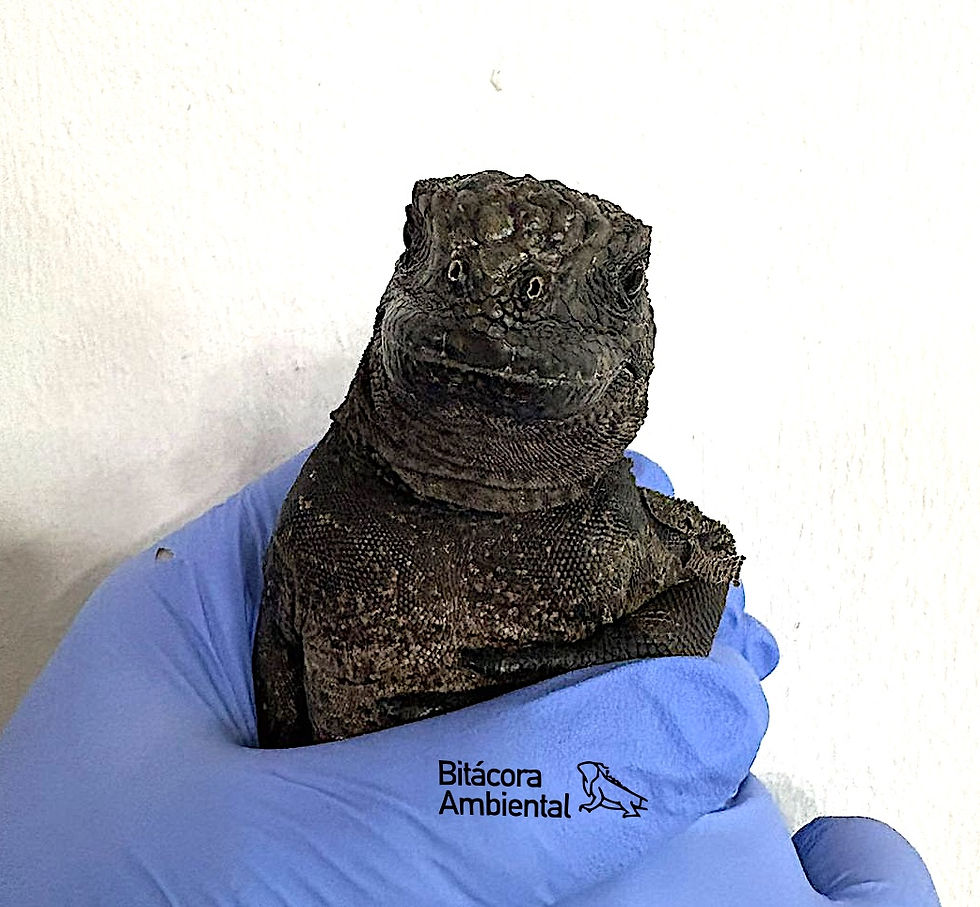
Four marine iguanas found in the same neighborhood
In less than a week, four juvenile Galápagos marine iguanas (Amblyrhynchus cristatus) appeared in the same area of Guayaquil, Ecuador’s main port city. All were found around a motorcycle repair shop in the Simón Bolívar neighborhood, directly across from José Joaquín de Olmedo International Airport.
The pattern is difficult to dismiss as coincidence.
The first iguana was discovered on May 12, 2026, by children playing soccer on a dirt field near the workshop. They described it as a “black iguana” hiding among dry leaves and handed it over to Ecuador’s Environmental Police Unit (UPMA).
A second juvenile appeared the following day and was rescued by the wildlife NGO Proyecto Sacha before being transferred to Ecuador’s Ministry of Environment through the Environmental Crimes Investigation Unit (#UNIDCAN).
Days later, a third iguana was found behind the same motorcycle shop. A fourth appeared nearby over the weekend and was temporarily kept in a cardboard box with lettuce and water by local residents until police arrived.
Marine iguanas are found naturally only in the Galápagos Islands, roughly 1,000 kilometers (620 miles) off Ecuador’s Pacific coast. They require saltwater environments, specialized marine algae diets, and coastal temperature conditions to survive.
According to a Galápagos reptile specialist consulted by Bitácora Ambiental, the animals appear to be between one and three years old. At that age, sex cannot yet be determined because sexual dimorphism has not fully developed. The expert warned that prolonged captivity without access to marine food and proper environmental conditions could rapidly trigger physiological deterioration.
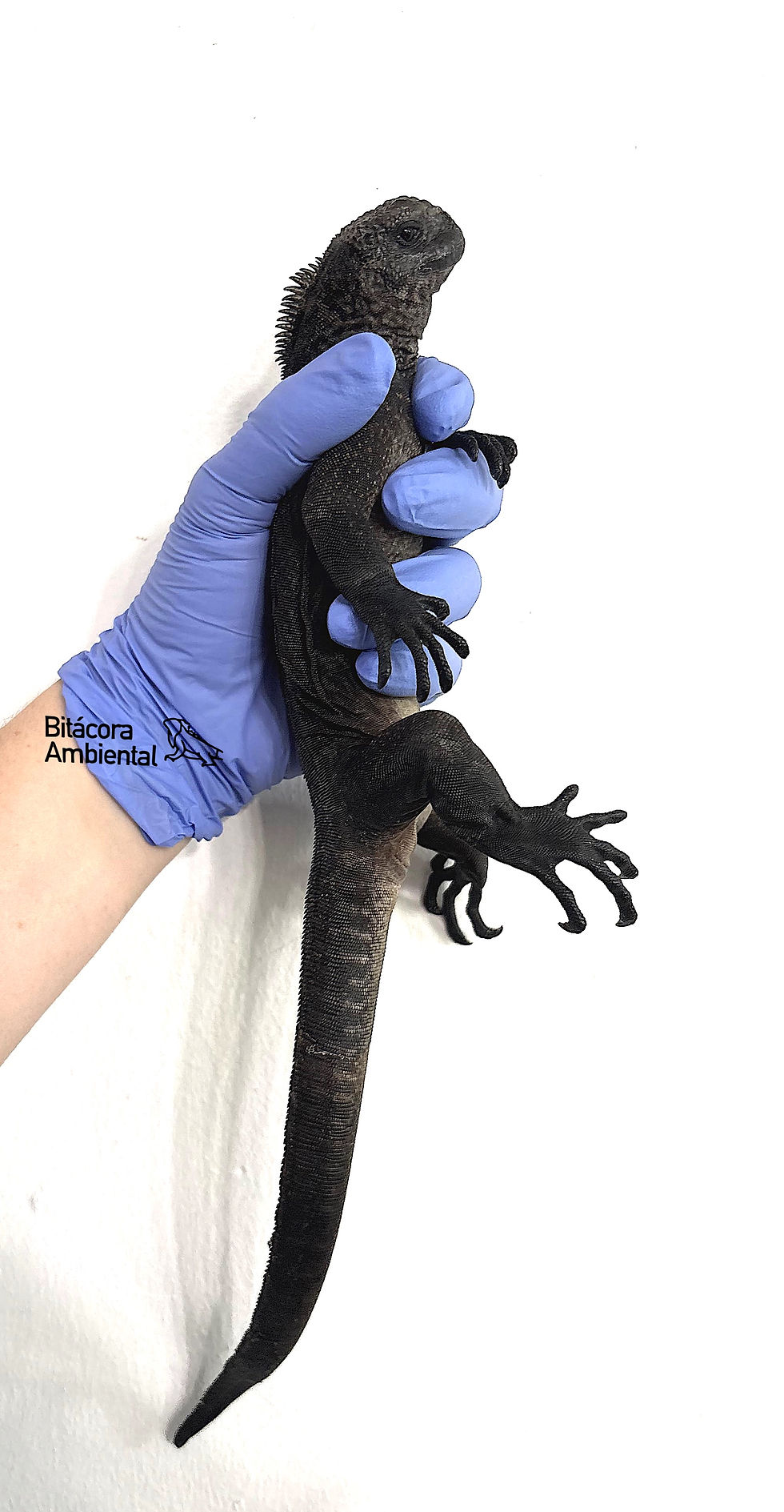
A growing pattern outside the Galápagos
The Guayaquil discoveries are not isolated.
Bitácora Ambiental previously documented the appearance of three marine iguanas on Isla de la Plata, inside Ecuador’s Machalilla National Park on the mainland coast — another highly unusual event for a species endemic to the Galápagos archipelago.
The repeated presence of marine iguanas outside the islands is beginning to suggest a broader trafficking pattern.
Marine iguanas do not naturally disperse to mainland Ecuador in clusters, nor do multiple juveniles suddenly appear in urban areas. The most plausible explanation is illegal extraction and transport.
In recent years, Bitácora Ambiental has investigated several cases involving Galápagos reptiles appearing in international wildlife trade records and exotic animal collections abroad:

Earlier warnings from Wolf Volcano
Official documents from the Galápagos National Park show that authorities had already raised concerns years ago about suspicious activity around Wolf Volcano, the only habitat of the critically endangered Galápagos pink iguana (Conolophus marthae).
In a letter sent to Ecuadorian police, former Galápagos National Park director Danny Rueda reported the disappearance of a wildlife monitoring camera and warned that a burrow previously occupied by a pink iguana showed signs of becoming inactive. Authorities suspected possible illegal capture activity.
Another internal memo ordered increased surveillance around northern Isabela Island and the access routes to Wolf Volcano, including monitoring vessels approaching the area.

Uganda and the international trade route
Concerns intensified after international CITES trade records began showing Galápagos iguanas exported from Uganda — despite Ecuador never authorizing the legal export of live marine iguanas or Galápagos land iguanas.
The operator of this traffic is the Wildlife UG and the CTC Conservation Center in Uganda. That facilities linked both marine and land iguanas from the Galápagos, along with other highly valuable reptile species. Records analyzed by Bitácora Ambiental show that Uganda reported exporting 54 Galápagos land iguanas between 2017 and 2022.
Additional export documents reviewed by this outlet indicate that at least:
four Galápagos marine iguanas,
and two Galápagos land iguanas
were shipped from Uganda to India in 2025, reportedly destined for the Greens Zoological Rescue and Rehabilitation Centre — better known internationally as the Vantara wildlife complex.
TRAFFIC report confirms broader criminal networks
A March 2026 report by the international NGO TRAFFIC concluded that organized wildlife trafficking networks are operating in the Galápagos Islands and moving species through mainland Ecuadorian cities such as Guayaquil and Manta before reaching European and Asian markets.
The report specifically documents cases involving Galápagos marine and land iguanas hidden in luggage and vessels between 2010 and 2022.
TRAFFIC also identified several structural weaknesses facilitating wildlife trafficking in the archipelago:
corruption,
weak institutional coordination,
deficient airport and port controls,
fragmented intelligence,
and shortages of environmental enforcement personnel.
The organization recommended strengthening criminal intelligence operations, adapting anti-trafficking chain-of-custody protocols for Galápagos airports and ports, and implementing anti-corruption measures in strategic control points.

A legal victory that failed to stop the trade
In 2022, Ecuadorian lawyer Milton Castillo and environmental journalist Franklin Vega won a landmark constitutional case demanding stronger protection against wildlife trafficking involving Galápagos species.
The ruling ordered Ecuador’s government to push for stronger international protections under CITES, improve genetic traceability systems, and strengthen controls against illegal wildlife trade.
Ecuador later succeeded in moving Galápagos marine iguanas, land iguanas, pink iguanas, and giant tortoises into stricter CITES protection categories.
Yet despite those legal and diplomatic victories, the trafficking signals have not disappeared.
The four juvenile marine iguanas found in Guayaquil suggest that international demand, organized trafficking networks, and weak environmental enforcement continue to threaten one of the world’s most iconic ecosystems.


Comments